
What the MPC hold means for your portfolio

The Central Bank of Nigeria’s decision to retain the Monetary Policy Rate (MPR) at 26.5 percent signals a cautious
monetary policy stance amid rising global uncertainty and geopolitical tensions linked to the Middle East crisis. Although investors initially expected the February rate cut to trigger strong bond market gains, rising yields have weakened that outlook. An investor holding an 11-year FGN bond with a nominal value of N5 billion would currently record a valuation loss of about N87.1 million, while a short-term 142-day instrument would lose only N2.7 million, highlighting the higher sensitivity of long-term securities to interest rate changes. Meanwhile, elevated yields may continue supporting Treasury bills, OMO bills, fixed deposits, and other short-term fixed-income investments.
Introduction
The Monetary Policy Committee (MPC) of the Central Bank of Nigeria (CBN) has voted to retain the Monetary
Policy Rate (MPR) at 26.5 percent, reflecting a cautious policy stance amid renewed inflationary pressures linked
to rising geopolitical tensions and elevated energy costs.
While some market participants initially viewed the February rate cut as the beginning of an easing cycle, the
Middle East crisis has weakened that outlook. The decision to hold rates reflects growing global uncertainty,
rising geopolitical tensions, and persistent pressure in global fixed-income markets.
The implication for investors is that, the era of elevated yields is not over yet.
Global central banks are becoming more cautious
Since the outbreak of the recent US-Iran conflict, major central banks across the world have largely adopted a
wait-and-see approach. At least 14 out of 19 central banks that met after the escalation held interest rates
unchanged, reflecting concerns over inflation risks, energy prices, and financial market volatility.
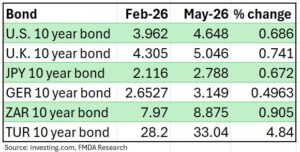
This cautious stance has also filtered into global bond markets, where yields have generally trended upward as
investors demand higher returns amid uncertainty. Nigeria has not been isolated from this development. Average Nigerian bond yields, which were around 15.86 percent in February, when the CBN last cut rates to 26.5 percent and Middle East tensions escalated, have now climbed to around 16.20 percent on average. This means the bond market is already pricing in a “higher-for-longer” interest rate environment.
What this means for fixed-income investors
For holders of government securities, the MPC hold decision presents a mixed outcome depending on the type of instrument being held. Long-term bond investors who were expected to benefit significantly from the previous rate cut in February have not fully enjoyed the projected valuation gains, as bond yields have remained elevated amid rising global uncertainty and geopolitical tensions.
Since bond prices move inversely to yields, the recent rise in yields has weakened price appreciation in long dated securities. Using average market yield movements for illustrative purposes, an investor holding an 11-year FGN bond with a nominal value of N5 billion would currently record a valuation loss of approximately N87.1 million relative to the February yield environment.
In contrast, a holder of a short-term 142-day instrument with the same nominal value would record a much smaller valuation loss of approximately N2.7 million. This highlights how long-term securities are significantly more sensitive to changes in interest rates than short-term instruments. With average bond yields rising from around 15.86 percent in February to about 16.20 percent currently, the expected bond rally following the earlier MPR cut has Short-term fixed-income investors, however, may benefit from elevated yields being preserved for longer. Treasury bills, OMO bills, commercial papers, and fixed deposits are therefore likely to continue offering relatively attractive returns compared to a more aggressive easing cycle
Savers may continue to benefit
The MPC hold decision also means deposit rates may not decline aggressively in the near term.
Savings account interest rates currently remain around 7.95 percent, compared to about 8.10 percent before the previous rate cut. While returns have moderated slightly, the decision to maintain rates suggests savers may continue to enjoy relatively elevated deposit yields for now.
For individuals relying on fixed-income investments or savings products, the hold decision delays the transition to a lower-yield environment.
Equity market remains resilient despite elevated rates
In our February analysis, we noted that the market had already returned over 20 percent in 2026 and could record another strong run given the rate cut. Since then, the market has significantly moved in that direction, with returns now rising to 60.87 percent as of May.
This suggests that investor sentiment in the equity market remains strong, supported not only by monetary policy expectations, but also by liquidity conditions and continued demand for fundamentally strong stocks.
Even with the MPC maintaining rates at 26.5 percent, equities may continue attracting investors.
Liquidity remains adequate, but rates may stay elevated
According to the recent FMDA Financial Market Risk & Liquidity Survey conducted in May among traders and treasurers, liquidity conditions in the financial system remain broadly adequate.
However, market participants broadly expect interest rates to remain elevated over the next six months, – reflecting continued caution within the financial system.
This expectation aligns with current bond market behaviour, where yields have remained firm despite the earlier policy easing.
Conclusion and outlook
The MPC’s decision to maintain the MPR at 26.5 percent suggests that monetary easing in Nigeria may proceed more gradually than some investors previously anticipated.
Global uncertainty, rising bond yields, and geopolitical risks are encouraging central banks worldwide to remain cautious, and Nigeria appears to be following the same path.
For investors, the message is increasingly glaring, yields may remain elevated for longer, preserving opportunities in fixed income, while limiting the scale of valuation gains expected from aggressive rate cuts.
In this environment, portfolio positioning may depend less on expectations of rapid easing and more on balancing yield opportunities with evolving market risks.
Global bond yields