
Nigeria Is back on JP Morgan’s Bond Index after 11 Years

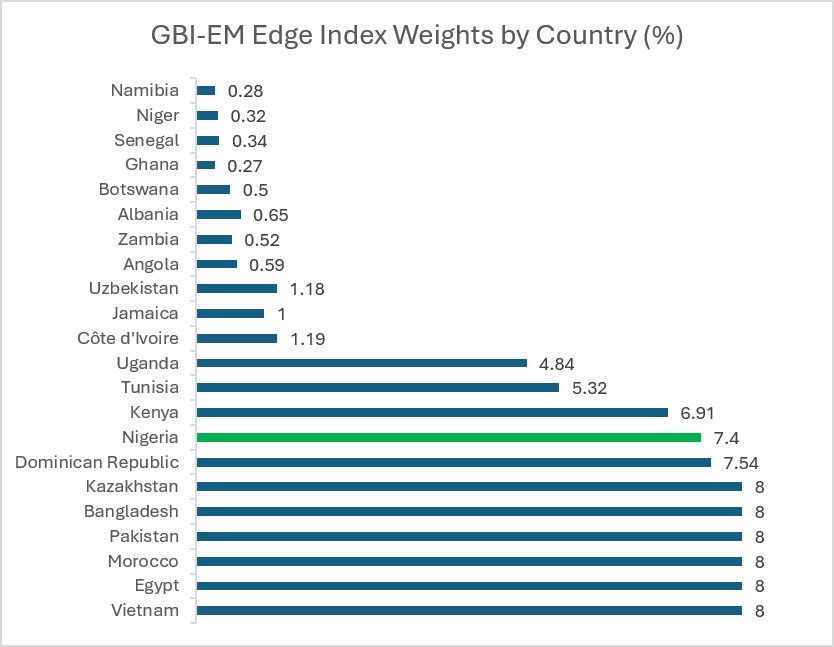
On 14 September 2026, JP Morgan, one of the world’s biggest banks, added Nigeria to a new bond index it created called the GBI-EM Edge, giving Nigeria a weight of 7.4%, one of the largest of the 26 countries on the list. In simple terms: for every $100 that global investors put into this index, roughly $7.40 is set to land in Nigerian government bonds.
Nigeria was once on a similar JP Morgan index but got kicked off in 2015 due to rigidity in the FX market. Eleven years later, it’s back.
Here’s what it means, in plain terms.
First, what is a “bond index”?
When a government needs money, it borrows by selling bonds, basically an IOU that pays interest (called a “yield”) over a number of years. Nigeria does this too, through naira-denominated government bonds (FGN bonds).
A “bond index” is simply a list, put together by JP Morgan, of government bonds from different countries that meet certain standards: it has to be big enough, foreign investors have to be able to get their money in and out without much trouble, prices have to be transparent, and so on.
Think of it like a recommended shopping list. Big global investment funds, pension funds, asset managers, insurance companies abroad, use these lists to decide which countries’ bonds are “safe enough” and “accessible enough” to buy. Many funds don’t pick countries one by one themselves; they buy whatever is on the list, in the proportion the list says. If your country isn’t on the list, most of that money simply never considers you, no matter how attractive your interest rate looks.
How does being on the list bring in investors? It majorly happens in two ways
Passive money: Funds that are built to automatically copy an index. Since Nigeria sits on the GBI-EM Edge with a 7.4% weight, these funds automatically put 7.4% of their money into Nigerian bonds, it just happens, on autopilot. So a passive fund with $1 billion tracking this index would automatically hold about $74 million in Nigerian government bonds, simply because that’s what the index says to do.
Active money: Fund managers who make discretionary investment decisions rather than replicating the index, but use it as a benchmark for portfolio construction and performance evaluation. If a manager likes Nigeria’s story, they can hold more than the 7.4% weight (“overweight”); if they’re cautious, they can hold less, or skip it entirely (“underweight”).
Either way, being on the list puts Nigeria back in front of people who manage real money, many of whom stopped looking at Nigeria after 2015 simply because it wasn’t on any list worth checking.
Nigeria’s 7.4% weight is close to the maximum any single country is allowed (8%, so no one market can dominate the index), backed by about $17.5 billion in eligible naira bonds across 16 different issues. Compare that to Ghana’s 0.27% or Niger’s similarly tiny slice, and it’s clear Nigeria isn’t a forgettable line item here, it’s one of the anchor markets. That said, it’s not a guaranteed inflow of a fixed dollar amount; how much actually shows up depends on how much total money ends up tracking this particular index.
Source: JP Morgan
The history: why Nigeria was thrown off in the first place
Nigeria first joined a JP Morgan bond index in October 2012. It didn’t last. By 2015, JP Morgan removed Nigeria, giving these reasons: the foreign exchange market was hard to access, investors struggled to convert their naira back into dollars and take their money out, exchange rates weren’t transparent, and there wasn’t a genuine two-way market for buying and selling dollars. This was the era of multiple, conflicting official exchange rates and heavy central bank restrictions following the 2014–2016 oil price crash.
For the next 11 years, that exclusion stuck. It fed a wider narrative: Nigeria was becoming harder, not easier, to invest in.
What changed: starting around 2023, the Central Bank of Nigeria pushed through a series of reforms to unify the exchange rate (collapsing the multiple official rates into one), introduced B-Match system for FX trading, improve transparency in how the rate is set, and make it easier for foreign investors to actually get dollars out when they want to exit. Discussions with JP Morgan about a possible return reopened in 2025. The reforms were judged sufficient, not perfect, but sufficient, for Nigeria to qualify for this new index.
One important nuance: Nigeria has not been let back into JP Morgan’s main, top-tier index, the GBI-EM Global Diversified (GBI-EM GD), the one it was thrown out of in 2015. It’s been placed in this new “Edge” index, a kind of second division for markets that are improving but haven’t yet proven themselves over a long enough period. The rule is that a country needs five consecutive years of strong performance against the GBI-EM GD’s criteria before it can be promoted. So this is a first step back, not a full return to the top table.
What happens to bond yields?
Nigeria’s bonds in the index currently pay an average yield of 17.1%, a lot higher than the roughly 10.4% average across the whole index, and higher than similarly-rated countries like Kenya (12.2%). That high yield exists because investors still see real risk in naira assets: currency swings, inflation, and Nigeria’s B- credit rating (below investment grade).
Being added to the index can, over time, put downward pressure on that yield. More buyers competing for the same bonds tends to push prices up and yields down, meaning it could eventually get cheaper for the Nigerian government to borrow. But this doesn’t happen overnight, and it isn’t automatic. It depends on how much real money actually flows in, and whether Nigeria keeps its reforms on track. If confidence slips, yields could just as easily stay high or rise.
What happens to FX inflow?
This is arguably the more important effect for the wider economy, not just for bond investors.
To buy a naira-denominated bond, a foreign investor first needs naira, which means selling dollars to get it. Every time that happens, dollars enter the Nigerian financial system through the official market. Multiply that across many foreign investors buying into the index over time, and it becomes a real, recurring source of dollar supply, distinct from oil exports, which swing with global oil prices and are increasingly less predictable.
More dollar supply through the official market can further strengthened Nigeria’s external reserves and allow the naira to remain on the appreciation trajectory. It’s not going to single-handedly make the currency get stronger, and it won’t directly touch the parallel (“black”) market rate that ordinary Nigerians deal with day to day. But as a structural, repeatable channel for foreign currency to enter the country, it’s a meaningful piece of the puzzle , and a big part of why the reforms were worth pursuing.
Bottom line
Getting back on this list is a genuine vote of confidence in Nigeria’s FX and bond-market reforms, not a symbolic gesture. It puts Nigeria back in front of global investors who had written it off, gives it one of the largest weightings among 26 countries, and creates a structural channel for dollars to flow in through the official market. Over time, that could mean cheaper government borrowing and steadier FX inflows. But it’s a second-tier index, not the big one, and the gains are conditional on Nigeria staying the reform course rather than something guaranteed to happen on its own.