Implications of Dangote Refinery Expansion on Nigeria’s Foreign Exchange Demand

IMPLICATIONS OF DANGOTE REFINERY EXPANSION ON NIGERIA’S FOREIGN EXCHANGE DEMAND
As Dangote Refinery sets on a historic trajectory of expansion from 650,000 barrels per day to 1.4 million barrels, more than double its current production capacity, alongside plans to list 10 percent of its stake to the public, the implications for Nigeria’s foreign exchange dynamics are significant.
Beyond fuel: Deepening Nigeria’s industrial base
The refinery’s plan to increase polypropylene output from 900,000 to 2.4 million metric tonnes per annum will not only deepen the local production of Linear Alkylbenzene (LAB), a key ingredient used in detergents, anti-rust agents, and paint additives, but will also enable additional base oil production.
This underlines the fact that petroleum refining is not just about PMS, diesel, or jet fuel. With the addition of a vacuum distillation unit (VDU), the refinery will be able to process residual fuel oils (RFOs), heavy distillates that are currently underutilized, into base oils. Once operational, this could eliminate the need for Nigeria’s annual importation of about 300 million litres of base oil, a major input in lubricant manufacturing.
Source: NBS
Import substitution and FX savings
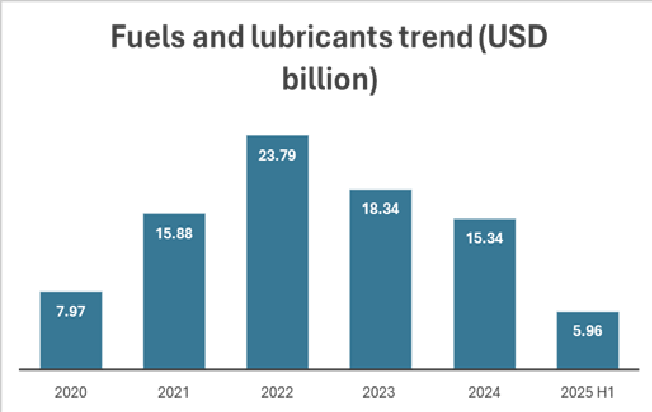
According to the National Bureau of Statistics (NBS), fuels and lubricants accounted for 28.4 percent of Nigeria’s total imports in Q2 2025, while industrial supplies made up another 24.6 percent. Together, these two categories represent more than half of the country’s import bill, equivalent to roughly N8.1 trillion within the quarter. A significant share of these imports includes refined petroleum products, lubricants, and base oils, items that the Dangote Refinery’s expansion directly targets to replace locally.
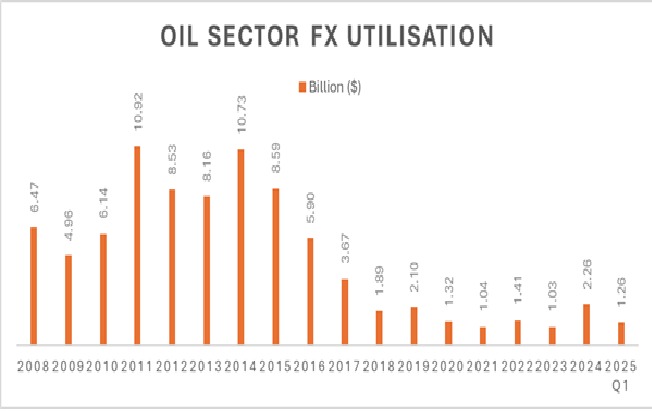
This transformation is particularly relevant when viewed against the trend of FX utilisation in Nigeria’s oil sector, which has fallen sharply over the past decade.
Between 2008 and 2014, FX demand from the oil sector averaged over $8 billion annually, peaking above $10 billion in 2011 and 2014. However, from 2016 onward, utilisation dropped below $2 billion, reaching as low as $1.03 billion in 2023 (see chart below).
Source: CBN
Crude imports and the FX paradox
Interestingly, oil sector FX utilisation rose to about $1.26 billion in Q1 2025, a noticeable jump compared to previous quarters. This uptick reflects a new reality rather than a return to heavy fuel importation. As domestic refineries, including Dangote and modular operators, begin operations, many have resorted to importing crude oil feedstock due to insufficient local supply caused by pricing differences and crude grade preferences among the refiners, as well as feedstock scheduling constraints with the Nigerian Upstream Petroleum Regulatory Commission (NUPRC).
In addition, the ongoing expansion phase of the Dangote Refinery, which will more than double its capacity, requires significant capital imports, including heavy equipment, catalysts, and process units. These activities are FX-intensive and are likely to sustain modest short-term pressure on Nigeria’s external reserves.
However, this pressure is transitional. Once the refinery’s second phase becomes operational, the combined output of refined petroleum, petrochemicals, and base oils will cut back billions in annual import costs, reversing Nigeria’s oil-sector FX drain into a net FX-saving position.
A new source of FX inflow
Furthermore, the planned public listing of 10 percent of the refinery’s shares could introduce a fresh FX inflow component. If foreign investors participate in the offer, it would attract new dollar inflows into Nigeria’s capital market, balancing the FX-saving effects of import substitution with potential FX inflows from equity investment.
Currently, Nigeria’s equities market records about N21 billion (around $14 million) in daily trades, with foreign investors accounting for roughly 20 percent or $3 million. Before policy distortions of the previous administration eroded investor confidence, foreign participation averaged $6 million daily. A return to that level would add about N5 billion in daily trades according to Analyst, deepening market liquidity and improving price discovery. Local investors also tend to become more active when foreign investors are in play, as they provide the much-needed counterparty depth in the market.
In this context, the public listing of Dangote Refinery, one of Africa’s most strategic industrial assets, could serve as a catalyst for renewed foreign participation, drawing both institutional and portfolio investors back into Nigerian equities.
The timing is also favourable. Nigeria’s recent removal from the Financial Action Task Force (FATF) Grey List signals improved compliance and transparency in its financial system, a key prerequisite for restoring investor confidence. Combined with the refinery’s global visibility and the government’s ongoing reform drive, the listing could help reposition Nigeria as a credible frontier investment destination, anchored by industrial strength and policy clarity.
In the medium term, the refinery’s forward integration into petrochemicals and base oils not only reduces dependence on foreign exchange but also redefines Nigeria’s oil sector as a catalyst for industrial growth, self-sufficiency, and currency stability.
In the medium term, the refinery’s forward integration into petrochemicals and base oils not only reduces dependence on foreign exchange but also redefines Nigeria’s oil sector as a catalyst for industrial growth, self-sufficiency, and currency stability.