How the MPR Cut Will Shape Your Investment Portfolio

The Monetary Policy Committee of the Central Bank of Nigeria (CBN) has voted to cut the Monetary Policy Rate (MPR), otherwise known as the benchmark interest rate, by 50 basis points from 27 percent to 26.5 percent. This is the first rate cut this year and the second since Olayemi Cardoso assumed office as CBN Governor. This marks a clear shift toward monetary easing after a long stretch of aggressive tightening.
Beyond the headline, the bigger question for investors is simple: how does this decision affect the value of your portfolio?
How rate cuts affect short-term and long-term instruments
When the CBN cuts the benchmark interest rate, the impact can be positive or negative depending on the type of investment you hold. Participants in the financial system include the government, companies, banks, institutional investors, and individuals. Some investors hold long-term financial instruments, such as government bonds, while others hold short-term instruments, such as Treasury bills, Open Market Operations (OMO) bills, and commercial papers.
Long-term security refers to financial assets held for over 12 months, while short-term security are low-risk, highly liquid financial instruments with maturities generally under one year.
For clarity, it is important to note that long-term financial instruments, such as government bonds, are more sensitive to changes in interest rates than short-term instruments. This means their value responds more strongly when interest rates rise or fall.
Let us assume an individual invests N100,000 in a fixed deposit account with a bank at an interest rate of 7.42 percent. When the fixed deposit matures usually under a year, reinvesting the funds may attract a lower interest rate due to the recent MPR cut. However, the decline may be gradual because the policy rate remains relatively high at 26.5 percent.
The same applies to Nigerian Treasury Bills (NTBs). For example, the current rate on the 91-day NTB is about 15.84 percent. As the MPR declines, the yield on Treasury bills may also decline. This means new investments in Treasury bills or similar instruments may offer lower returns compared to previous periods.
Institutional investors and high-net-worth individuals
This same dynamic applies to institutional investors and high-net-worth individuals (HNWIs), who actively participate in government bond and Treasury bill markets. However, holders of long-term instruments tend to benefit more when interest rates decline.
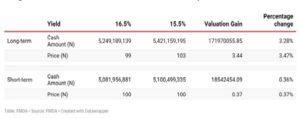
For example, if an institutional investor invested N5 billion in a 5-year FGN bond (maturing April 2031) when yields were around 16.50 percent, the price of that bond would be about N99.09 per N100 face value.
Following the MPR cut, if the bond yield declines to 15.50 percent, the price of the bond would increase to approximately N102.53. This represents a gain of N3.44 per N100 face value.
If the same N5 billion had been invested in a short-term 142-day instrument, the price would initially be N99.80. If the yield declines to 15.50 percent due to the MPR cut, the price would increase slightly to N100.17, representing a gain of only N0.37 per N100 face value.
In valuation terms:
- The 5-year bond would generate approximately N172 million in valuation gains.
- The 142-day instrument would generate approximately N18 million in valuation gains.
The key difference is the time to maturity. The longer the maturity, the more sensitive the instrument is to interest rate changes.
If the investor decides to sell the 5-year bond in the secondary market, it could be sold at around N102.53, representing over 3 percent gain in price. In contrast, the short-term instrument would gain less than 1 percent.
The secondary market allows investors to buy and sell government securities after the initial auction.
This example also highlights an important principle: bond prices and yields move in opposite directions. When yields fall, prices rise.
Implications for government and corporate borrowing
As yields decline, both the government and companies can borrow at lower interest rates when issuing new debt through FGN bond auctions, Treasury bills, or commercial papers. This reduces borrowing costs and improves financial conditions across the economy.
Investors who entered the market earlier at higher yields benefit the most, as their existing investments increase in value.
Equities: A boost from cheaper money
Lower interest rates can also support the stock market. When borrowing costs decline, companies can access cheaper financing, which may improve profitability and business expansion.
In 2025 alone, the Nigerian stock market returned 51.2 percent, while 2026 has delivered over 20 percent so far. With the economy now entering a lower-rate cycle, the stock market may continue to benefit.
Additionally, investors may shift funds from fixed-income investments into equities in search of higher returns, which can further support stock prices.
Money market funds: Expect lower returns
While bondholders benefit from rising prices, money market investors may experience declining returns.
Yields on Treasury bills, OMO bills, and fixed deposits may gradually decline as the MPR falls. This means that reinvesting funds after maturity may result in lower returns than before.
For example, a fixed deposit that previously earned a higher interest rate may now earn a lower rate upon reinvestment.
Borrowers vs savers
Borrowers benefit from lower interest rates, as loans may become cheaper and more accessible. However, the extent of this benefit depends on how quickly banks adjust their lending rates.
Savers, on the other hand, may earn lower returns on fixed deposits, Treasury bills, and money market investments as yields decline.
Conclusion and outlook
The CBN’s rate cut marks an important turning point for financial markets. Further cautious easing may occur if inflation continues to decline.
The key takeaway for investors is that falling interest rates increase the value of existing long-term investments. For example, the 5-year bond in this analysis increased from N99.09 to N102.53 following a decline in yields.
Investors who positioned early by investing when yields were high stand to benefit the most, while those entering the market later may face lower returns.