

CBN Rate Reset Begins to Restore Policy Transmission as Market Yields Fall

The Central Bank of Nigeria (CBN)’s recent decision to reset the Monetary Policy Rate (MPR) to 23% from 26.5% marks more than a shift in policy stance, it signals the beginning of a restoration in monetary policy transmission across financial markets.
Early market data already suggests that this transmission is gaining traction. Between September 18 and September 25, yields across key fixed-income instruments declined significantly. Average Treasury bill yields fell from 18.77 percent to 17.81 percent, a 96 basis point drop, while OMO yields declined more sharply by 129 basis points, reflecting a strong adjustment in liquidity-sensitive segments of the market.
| T-bill Yield | 18/09/2026 | 25/09/2026 | % Change |
| 1M | 17.88 | 17.01 | -0.87 |
| 3M | 17.85 | 17.05 | -0.80 |
| 6M | 19.04 | 17.84 | -1.20 |
| 9M | 19.76 | 18.90 | -0.85 |
| 12M | 19.31 | 18.23 | -1.08 |
| AVG. Yield | 18.77 | 17.81 | -0.96 |
Source: CBN, FMDA
| OMO Yield | 18/09/2026 | 25/09/2026 | % Change |
| 1M | 20.43 | 19.28 | -1.14 |
| 3M | 19.17 | 18.23 | -0.94 |
| 6M | 19.80 | 18.01 | -1.79 |
| AVG. Yield | 19.80 | 18.51 | -1.29 |
Source: CBN, FMDA
The bond market also responded, with average yields moderating from 16.5 percent to 16.0 percent. Notably, longer-dated securities saw more pronounced declines, with yields on 15-year and 30-year bonds falling by as much as 195 and 76 basis points respectively.
| Bond Yield | 18/09/2026 | 25/09/2026 | % Change |
| 1YR | 16.7 | 17.2 | 0.57 |
| 2YR | 16.5 | 15.7 | -0.79 |
| 4YR | 16.6 | 16.7 | 0.11 |
| 5 YR | 16.9 | 16.8 | -0.10 |
| 7 YR | 16.9 | 16.4 | -0.49 |
| 10 YR | 16.7 | 16.4 | -0.37 |
| 15 YR | 16.35 | 14.40 | -1.95 |
| 30 YR | 15.29 | 14.53 | -0.76 |
| Avg. Yield | 16.5 | 16.0 | -0.5 |
Source: CBN, FMDA
This reinforces the typical pattern in an easing environment, where long-term bondholders benefit more from valuation gains due to higher duration sensitivity. The scale of compression at the long end also suggests a gradual extension in investor positioning, as market participants seek to lock in prevailing yields amid expectations of further rate moderation.
NOFR and the return of policy transmission
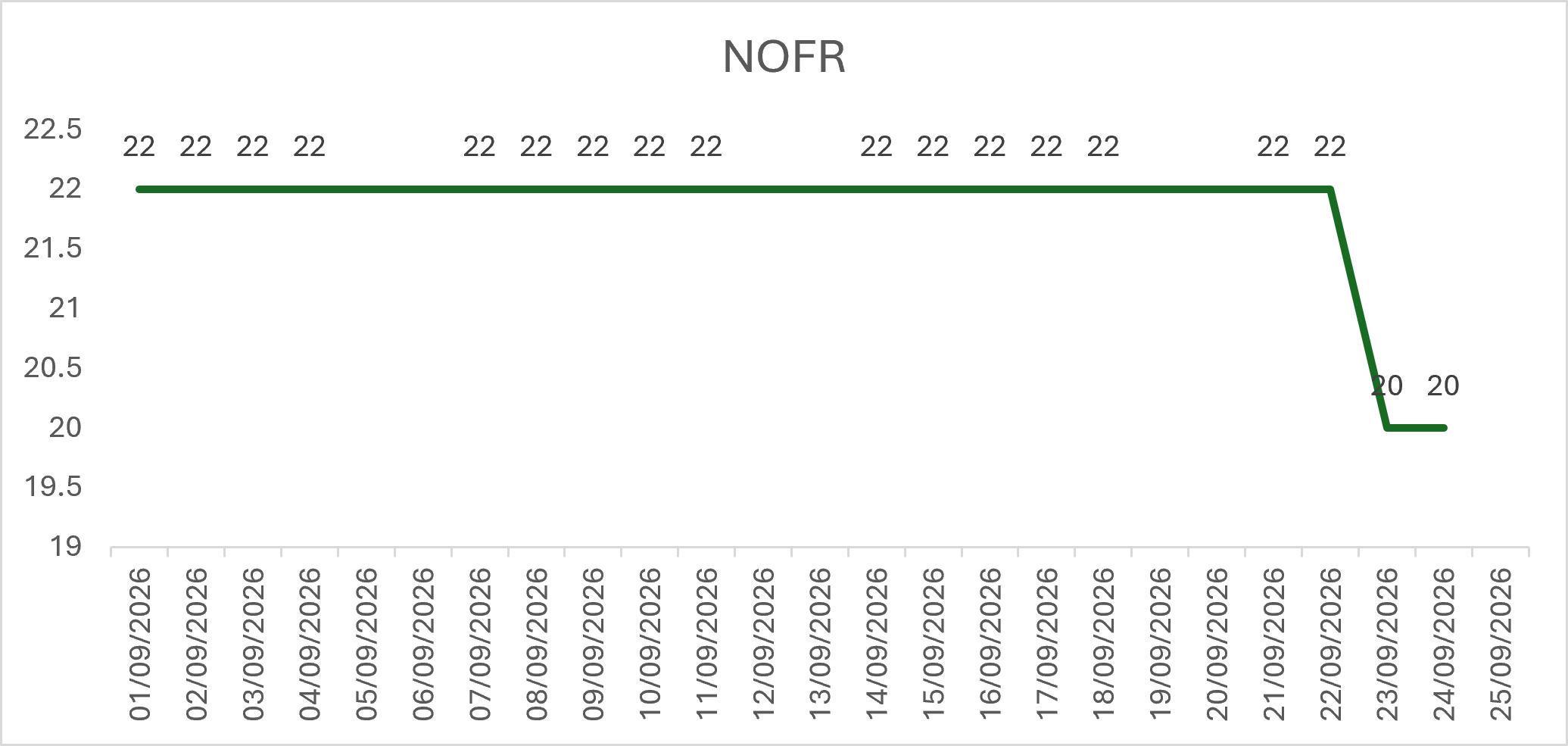
The adjustment is even more evident in short-term funding conditions. Recent data on the Nigerian Overnight Financing Rate (NOFR) shows that the weighted average rate declined from about 22.0 percent prior to the MPC decision to around 20.0 percent immediately after.
This roughly 200 basis point drop reflects a sharp easing in interbank funding costs, indicating that liquidity conditions are beginning to respond to the policy shift.
While some analysts have questioned the relevance of NOFR on the basis that it reflects interbank activity and is not directly accessible to the general public, a concern often raised in the Nigerian market, its importance lies in what it measures rather than who can access it. NOFR is a transaction-based benchmark rate derived from actual overnight secured lending and serves as a key indicator of short-term funding conditions within the financial system.
Introduced in April, NOFR replaces legacy benchmarks such as NIBOR, OBB, and OVN, which historically guided short-term naira funding and the pricing of money market instruments. These earlier benchmarks were largely contribution-based, relying on indicative quotes from market participants, and were therefore more susceptible to pricing biases and limited transparency.
The introduction of NOFR marks a structural shift in Nigeria’s benchmark architecture, from quote-based references toward a more transparent, standardised, and transaction-driven framework. This aligns with the CBN’s broader money market and fixed-income market reforms aimed at improving pricing accuracy and market efficiency.
Beyond the interbank market, NOFR has practical implications for the broader financial system. With its introduction, the market now has a more reliable reference rate for pricing financial assets, loan valuation, and general transaction pricing, areas that directly affect the broader public.
Whether it is the CBN, banks, corporates, or even individuals participating in financial markets, NOFR is gradually emerging as a benchmark rate to guide pricing decisions. While this transition may not be immediate, as the market continues to evolve, NOFR is already a key reference point for policymakers and is increasingly becoming one for broader market participants.
This is why the CBN has consistently emphasised the role of NOFR in strengthening monetary policy transmission by aligning policy signals more closely with actual market conditions. At its introduction in April, NOFR was positioned as a key reform to improve transparency and provide a more reliable benchmark for short-term funding conditions.
More recently, during the MPC communication, the CBN Governor acknowledged that the divergence between the MPR and prevailing market rates, captured through indicators such as NOFR, had weakened policy effectiveness, reinforcing the need to recalibrate policy and restore alignment.
Market behaviour confirms shifting expectations
Developments in the primary market further reinforce this trend.
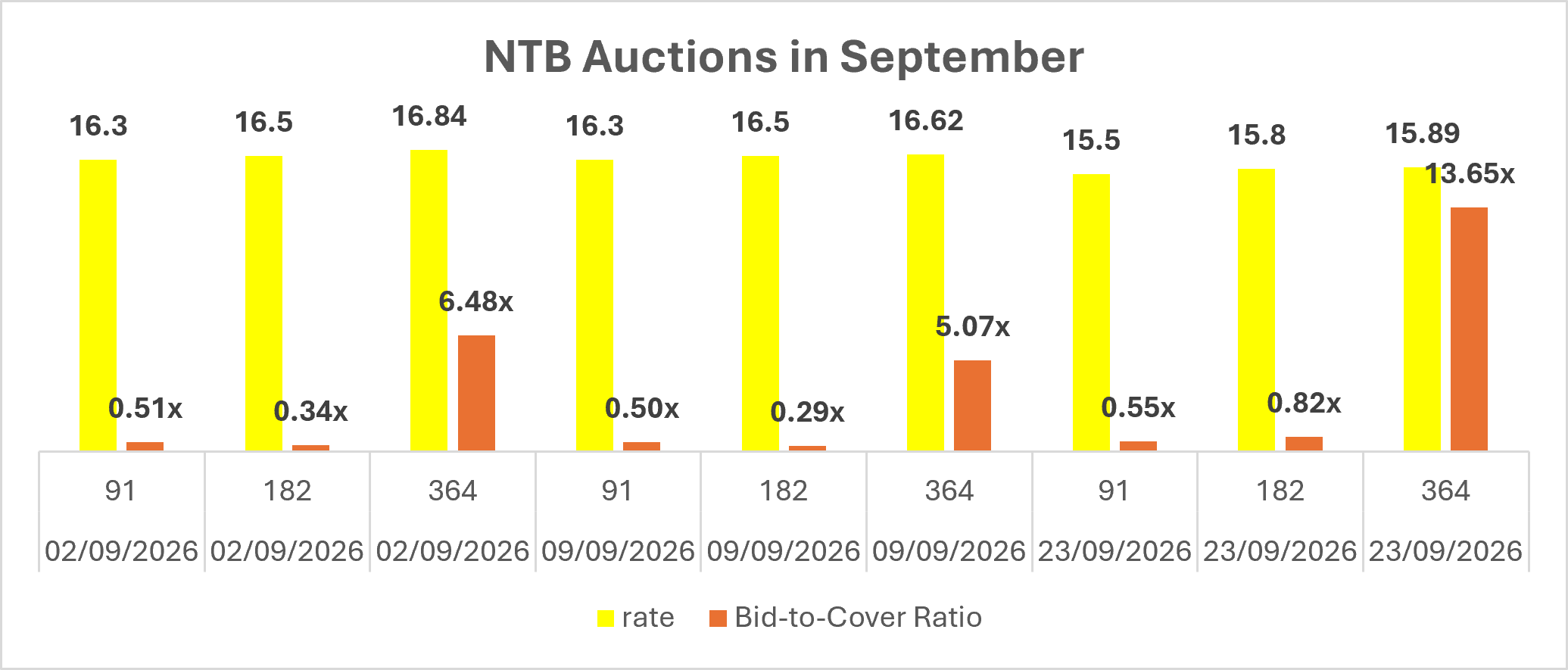
At the most recent Treasury bills auction, investor demand was heavily concentrated on the 364-day tenor, which recorded a bid-to-cover ratio of 13.65x, significantly higher than previous auctions. This reflects strong investor appetite to lock in longer-dated yields following the MPR reset.
In contrast, demand at the short end remained relatively weak, highlighting a clear rotation toward longer-dated instruments as market participants adjust to a lower-rate environment.
Stop rates also declined across all tenors, falling to 15.50 percent for the 91-day, 15.80 percent for the 182-day, and 15.89 percent for the 364-day bill, reflecting the combined impact of improved system liquidity, the MPR reset, and shifting investor expectations.
Source: CBN, FMDA
Reassessing the CRR debate
While concerns around the high Cash Reserve Ratio (CRR) remain valid, its impact on bank lending is more nuanced in practice. Some analysts argue that the current CRR level is a major constraint on credit creation and have suggested that it should be reduced significantly, even to zero, to unlock lending.
A key point often overlooked is that the effective impact of CRR depends not just on the headline rate, but on the composition of deposits within the banking system. Recent calculations show that when CRR was at 50 percent, the absolute amount of funds sterilised was higher than in the current framework, where a 45 percent CRR applies to private sector deposits alongside a 75 percent CRR on non-TSA balances.
Despite the higher rate on non-TSA funds, the overall volume of sterilised liquidity has declined, reflecting the smaller base to which the higher CRR is applied. This suggests that the liquidity impact of CRR is more nuanced and depends critically on deposit structure rather than headline rates alone.
In addition, CRR operations are not static. Market participants indicate that CRR debits and credits are typically executed on a periodic basis, often around two-week intervals, rather than representing a permanently locked pool of funds. This introduces a timing element into liquidity conditions, where banks may experience fluctuations in available funds rather than a continuous constraint.
In this context, the effect of CRR is more likely to influence short-term liquidity management and investment decisions, including participation in money market instruments, rather than acting as a direct and binding constraint on lending.
As such, while CRR plays an important role in liquidity management, bank lending decisions remain more strongly driven by pricing conditions, risk assessment, and the broader interest rate environment. This reinforces the importance of recent efforts to improve policy transmission through better alignment between the MPR and actual market rates.
Conclusion: From policy signal to market reality
Taken together, these developments point to a critical shift in Nigeria’s monetary framework.
The transmission of monetary policy, long weakened by the disconnect between policy rates and market conditions, is beginning to improve. The alignment between the MPR and market benchmarks such as NOFR is gradually anchoring pricing across the financial system, from interbank funding to government securities and investor behaviour.
In this sense, the recent rate reset is not just about easing financial conditions, it is about restoring credibility to the policy transmission mechanism itself.